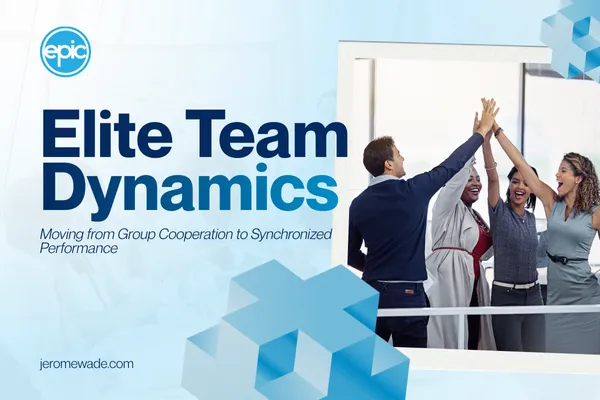
Elite Team Dynamics: Moving from Group Cooperation to Synchronized Performance
"Leadership and learning are indispensable to each other." — John F. Kennedy
Cooperation vs. Synchronization
The Difference Between Cooperation and Synchronization
Most corporate teams are merely "cooperating." They share a CRM, attend the same Slack channels, and work toward a common KPI. However, in high-stakes environments—like elite athletics or special operations—cooperation is the bare minimum. The goal is Synchronization.
Synchronization occurs when a team moves beyond individual task management into a state of "Collective Flow." At Epic Life Global, we help organizations transition from a collection of high-performers to a high-performance unit. This shift is the difference between incremental growth and exponential market dominance.
The Anatomy of High-Performance Synergy
To achieve synchronized performance, a team must master three distinct dimensions of human potential:
1. Psychological Safety as a Performance Metric Google’s Project Aristotle famously found that psychological safety was the number one predictor of team success. But for an Epic Life, safety isn't just about "being nice." It is the biological prerequisite for innovation. When a team member fears judgment, their prefrontal cortex shuts down, and they enter "defensive mode." We train leaders to build "High-Challenge, High-Support" environments where the brain stays in "Growth Mode."
2. Cognitive Load Management A team’s performance is limited by its collective cognitive load. If your team is bogged down by redundant meetings, "performative" emails, and unclear hierarchies, they are wasting 40% of their intellectual capital on friction. We implement "Communication Architecture" that protects deep work and ensures that when the team does collaborate, it is high-impact.
3. The Shared Pulse (Physiological Coherence) Research shows that highly effective teams actually synchronize their heart rate variability (HRV) during intense collaboration. We teach teams how to regulate their collective stress levels so that when the pressure rises, the team becomes calmer and more precise, rather than more frantic.
Scaling the "Elite" Culture
The byproduct of synchronized performance is a self-correcting culture. High-performing teams don't need micro-management; they need vision and alignment. When you optimize the human potential of the group, you create a "Gravity Well" that attracts top talent and repels mediocrity.
Move Beyond the Dashboard. Real sales leadership happens in the gaps between the metrics. Jerome trains Sales Leaders to manage the energy and resilience of their hunters for maximum output.
[Request a Sales Strategy briefing with Jerome.]


